
Choosing the Right Adhesive: The Difference Between Solid Surface, Quartz, and Sintered Stone Bonding Solutions
In the world of modern fabrication and interior design, materials like solid surface, quartz stone, and sintered stone are revolutionizing how we build countertops, vanities, and wall systems. Each of these materials has unique properties — and therefore requires a different type of adhesive to ensure reliable, seamless bonding.
Spider Adhesive
1/18/20254 min read
Introduction
In the world of modern fabrication and interior design, materials like solid surface, quartz stone, and sintered stone are revolutionizing how we build countertops, vanities, and wall systems. Each of these materials has unique properties — and therefore requires a different type of adhesive to ensure reliable, seamless bonding.
At Spider Adhesive, we often receive questions such as:
“Can I use the same glue for quartz and solid surface?”
“Why does my adhesive turn yellow on porcelain slabs?”
“Which type of adhesive gives the strongest bond?”
In this article, we’ll break down the differences between these materials, explain which adhesives work best, and share expert advice on achieving professional results every time.
1. Understanding the Three Materials
Before selecting the right adhesive, it’s essential to understand what makes each surface type unique.
🧱Solid Surface (Acrylic or Polyester-based)
Solid surface materials (like Corian® or HI-MACS®) are man-made composites consisting of acrylic or polyester resins mixed with mineral fillers.
They are:
Non-porous, repairable, and seamless
Relatively soft and easy to fabricate
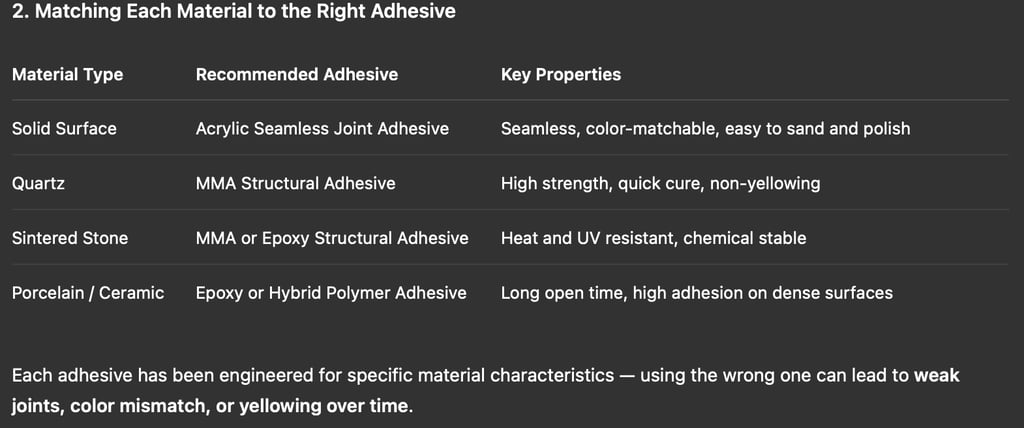
Often joined using acrylic-based seamless joint adhesives
These materials are ideal for kitchen countertops, bathrooms, and medical or hospitality projects where hygiene and aesthetics matter.
💎Quartz Stone (Engineered Stone)
Quartz stone, or engineered stone, is composed of 90–95% natural quartz crystals bound together with resin.
It’s extremely durable, scratch-resistant, and visually appealing — but it’s also harder and less flexible than solid surface.
Quartz typically requires MMA (methyl methacrylate) or color-matched two-part adhesives, formulated to handle its high density and low porosity.
🪨Sintered Stone (Porcelain Slab)
Sintered stone is made by compressing natural minerals at high temperature, creating a dense, ultra-hard surface.
It’s heat-resistant, UV-stable, and waterproof — but very low in surface energy, meaning standard glues won’t adhere well.
For this reason, special MMA or epoxy adhesives are the preferred choice.
3. Key Performance Factors to Consider
When comparing adhesives, pay attention to the following performance parameters:
⚙️Bond Strength
Measured in MPa (megapascals), this determines how much load or pressure the bond can withstand.
MMA and epoxy adhesives typically offer 15–25 MPa shear strength — enough for heavy-duty structural joints.
⏱️Curing Time
Acrylic adhesives cure in 10–20 minutes, ideal for fast production.
Epoxy adhesives may take longer but provide superior heat and chemical resistance.
🎨Color Stability
UV exposure can cause yellowing, especially in low-grade glues.
Spider’s MMA and acrylic adhesives are non-yellowing, ensuring the joint remains invisible over time.
🌡️Temperature Resistance
For kitchens or outdoor projects, adhesives must withstand temperature swings and UV light.
Epoxy and high-performance MMA formulas are best for these applications.
🧪Viscosity and Flow
Low-viscosity adhesives flow easily for thin seams, while higher-viscosity ones are better for vertical or irregular joints.
4. Real-World Application Tips
To achieve a professional result, it’s not just about product choice — application technique matters too.
🧽 1.Clean the Surface Thoroughly
Remove dust, oil, and polishing residues using alcohol or acetone.
Even small contaminants can weaken the bond.
🧴 2.Use a Static Mixing Nozzle
Always use the correct dispensing gun and mixing tip to ensure consistent 10:1 ratio and proper polymerization.
🪚 3.Avoid Over-Clamping
Excessive clamping squeezes out too much adhesive, resulting in thin or weak joints.
⏱️ 4.Control the Environment
Ideal working temperature: 18–25°C (65–77°F).
Lower temperatures may slow curing; higher temperatures shorten open time.
✨ 5.Finishing and Polishing
After curing, remove excess adhesive and polish to achieve a seamless finish — especially for solid surface countertops.
5. Common Mistakes to Avoid
Even seasoned fabricators can fall into these traps:
Using general-purpose glue on sintered stone
Ignoring color matching for quartz joints
Failing to clean the surface before bonding
Mixing by hand (causes incomplete curing)
Using expired adhesives — shelf life matters!
Remember: a good adhesive can’t perform its best if applied incorrectly.
6. Market Insights and Trends
The global decorative surfaces market is evolving rapidly. According to industry data:
Solid surface is growing at 6% CAGR, driven by hygiene-focused commercial spaces
Quartz remains the top choice for mid-to-high-end kitchens, especially in North America and Europe
Sintered stone demand is increasing fastest — expected to reach USD 30 billion by 2030
This growth fuels rising demand for professional adhesive systems that combine aesthetics, speed, and strength.
Manufacturers and fabricators who invest in reliable bonding technology gain a clear advantage: faster installations, fewer callbacks, and more satisfied customers.
7. Why Spider Adhesive Leads the Bonding Revolution
With over 20 years of adhesive engineering experience, Spider Adhesive is more than a manufacturer — we’re a trusted partner for global fabricators and distributors.
Our adhesive range includes:
Acrylic Seamless Joint Adhesive for solid surface
MMA Structural Adhesive for quartz and sintered stone
Epoxy Structural Adhesive for high-temperature or outdoor use
✅ Key Benefits:
Perfect color matching for all major surface brands
Non-yellowing, fast-curing, and easy-to-apply formulas
Reliable OEM/ODM services and global supply capabilities
Consistent batch quality with strong technical support
Whether you’re fabricating countertops, laminating slabs, or installing large panels, Spider Adhesive helps you build stronger, seamless, and longer-lasting connections.
Conclusion
Each surface material deserves its perfect match — and the right adhesive makes all the difference.
By understanding the properties of solid surface, quartz, and sintered stone, you can select adhesives that not only hold but enhance the beauty and durability of your creations.
At Spider Adhesive, we’re here to make bonding simple, professional, and dependable — across every project and every surface.
Spider Adhesive — One Brand. Every Bond.
© 2025 All Rights Reserved, SpiderAdhesive.com


We are a professional adhesive manufacturer and supplier committed to providing advanced bonding solutions for solid surface, quartz, composites, metals, plastics, and other materials.
Contacts:
+86 13686659250
jackspideradhesive@gmail.com
Foshan,China