
MMA Structural Adhesive vs Epoxy Adhesive — What’s the Difference and When to Use Each?
When it comes to industrial bonding, few debates are as common as MMA vs Epoxy. Both are strong, reliable, and widely used — but their differences can make or break your project depending on the material, environment, and performance needs.
Spider Adhesive
7/28/20253 min read


When it comes to industrial bonding, few debates are as common as MMA vs Epoxy.
Both are strong, reliable, and widely used — but their differences can make or break your project depending on the material, environment, and performance needs.
In this article, we’ll break down the two types of adhesives in simple terms, compare their strengths and weaknesses, and help you decide which one fits your application best.
1. What Is an MMA Structural Adhesive?
MMA (Methyl Methacrylate) structural adhesive is a two-part adhesive made from methyl methacrylate resin and a hardener.
When mixed, it chemically reacts to form an extremely tough and flexible bond.
Key Features:
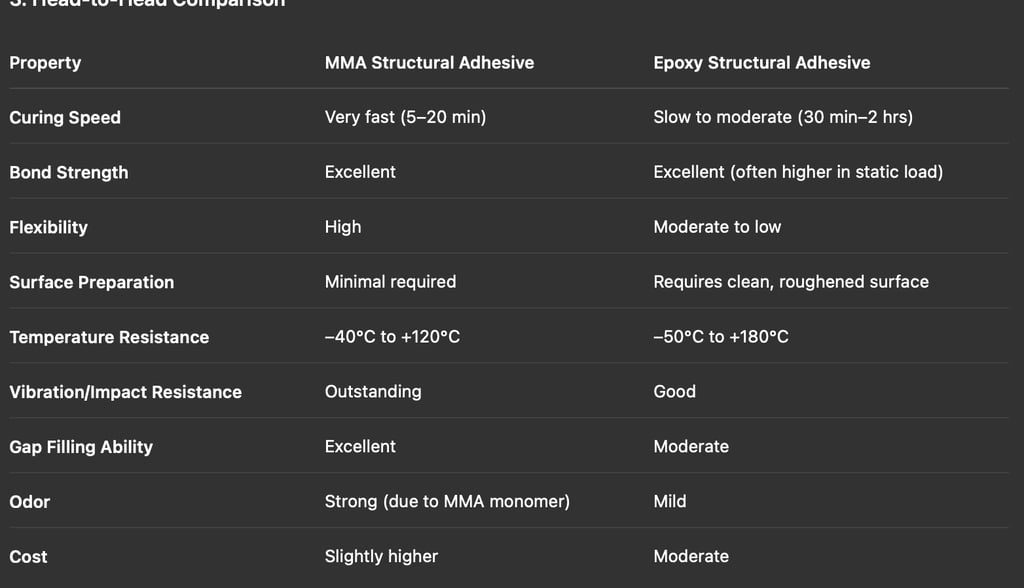
Fast curing (typically 5–20 minutes)
Excellent impact and vibration resistance
Strong adhesion to metals, composites, and plastics
High tolerance to surface contamination
Can be used in temperatures from –40°C to +120°C
In short, MMA adhesives are known for being “tough yet flexible.” They can handle harsh conditions and dynamic stress — which makes them ideal for automotive, marine, and composite assembly.
2. What Is an Epoxy Structural Adhesive?
Epoxy adhesives are based on epoxy resin and a hardener (curing agent).
They cure to form a rigid, extremely strong bond that’s known for durability and chemical resistance.
Key Features:
Exceptional strength on metals and composites
Excellent resistance to heat, chemicals, and fatigue
Longer working time (more time to position parts)
Available in flexible or rigid formulations
Often used in aerospace, construction, and electronics
Epoxy adhesives are the go-to choice for applications where stability and long-term load bearing are crucial.
4. When to Use MMA Adhesives
Choose MMA adhesives when:
You need quick curing for fast production.
The parts will face shock, vibration, or movement.
You’re bonding dissimilar materials (like metal to composite or plastic).
Surface preparation is difficult or time-consuming.
Industries: Automotive, marine, railway, signage, composites, construction panels.
Example: Bonding fiberglass parts on a boat hull — MMA adhesive ensures strong, flexible joints that withstand impact and water exposure.
5. When to Use Epoxy Adhesives
Choose epoxy adhesives when:
You need maximum structural strength under static loads.
The bonded parts will be exposed to high heat or chemicals.
You need more working time for precise alignment.
A smooth, high-gloss surface finish is important.
Industries: Aerospace, wind energy, metal fabrication, building reinforcement, electronics.
Example: Bonding carbon fiber or metal beams in an aircraft interior — epoxy offers unbeatable load-bearing strength and temperature stability.
6. The Market Perspective
Global demand for structural adhesives is growing rapidly, with both MMA and epoxy leading the market.
However, the trend is shifting toward faster-curing, low-VOC MMA systems due to higher efficiency and sustainability requirements.
Europe and North America, in particular, are seeing increased adoption of MMA adhesives for automotive lightweighting and epoxy systems for composite reinforcement.
Spider Adhesive stays ahead by offering:
Fast-curing MMA adhesives (10:1 ratio)
High-performance epoxy adhesives for industrial use
Custom formulations for special bonding surfaces
7. Expert Tip: Don’t Choose Based on Strength Alone
Both MMA and epoxy adhesives are strong — the real difference lies in how they perform under different stresses.
If flexibility and speed are priorities → go MMA.
If rigidity and heat resistance are critical → go Epoxy.
Sometimes, hybrid bonding solutions using both systems (e.g., MMA for initial set, epoxy for reinforcement) deliver the best of both worlds.
8. Conclusion
In the world of structural bonding, there’s no one-size-fits-all answer.
Both MMA and Epoxy adhesives have earned their place as champions of performance and reliability — the right choice depends on your specific project.
At Spider Adhesive, we understand the science behind each system and offer tailored solutions for manufacturers in construction, transportation, and composite fabrication.
Whether your goal is speed, strength, or versatility — we have the perfect adhesive for your success.
© 2025 All Rights Reserved, SpiderAdhesive.com


We are a professional adhesive manufacturer and supplier committed to providing advanced bonding solutions for solid surface, quartz, composites, metals, plastics, and other materials.
Contacts:
+86 13686659250
jackspideradhesive@gmail.com
Foshan,China