
Sintered Stone Bonding Guide: Achieving Perfect Seams with the Right Adhesive
Sintered stone — also known as porcelain slab or large-format ceramic surface — has become a designer’s favorite for its elegance, durability, and versatility. From high-end kitchen countertops and wall claddings to luxurious bathroom vanities, sintered stone delivers stunning aesthetics and long-lasting performance.
Spider Adhesive
12/30/20244 min read
Introduction
Sintered stone — also known as porcelain slab or large-format ceramic surface — has become a designer’s favorite for its elegance, durability, and versatility. From high-end kitchen countertops and wall claddings to luxurious bathroom vanities, sintered stone delivers stunning aesthetics and long-lasting performance.
But while the material itself is nearly indestructible, bonding it correctly is an entirely different challenge.
Sintered stone is dense, non-porous, and heat-resistant, which makes it difficult for ordinary glues to adhere properly.
That’s why professional fabricators and installers trust Spider Adhesive’s specialized structural adhesives — designed to deliver strong, seamless, and color-matched bonds for sintered stone applications.
In this article, we’ll dive into:
How sintered stone differs from other materials
Why adhesive selection is crucial
The types of adhesives best suited for sintered stone
Practical bonding and finishing tips
Current market trends and customer insights
1. What Makes Sintered Stone Special?
Sintered stone is produced by compressing and heating natural minerals at extremely high temperatures (over 1200°C), a process known as sintering.
This results in a surface that’s:
Non-porous and waterproof
Scratch and heat resistant
UV-stable and environmentally friendly
Available in ultra-thin yet strong panels (3mm–20mm)
These properties make sintered stone ideal for
Kitchen countertops
Bathroom walls and floors
Furniture surfaces and cabinet doors
Building façades and outdoor applications
However, because of its low surface energy, sintered stone can be tricky to bond — not every adhesive can achieve strong adhesion to such a smooth, inert surface.
2. The Challenge: Why Sintered Stone Needs Special Adhesives
Unlike porous materials like quartz or natural stone, sintered stone doesn’t absorb adhesive into its surface.
Standard glues (such as silicone or basic epoxy) often fail because they can’t penetrate or chemically anchor to the dense surface.
To achieve a reliable, long-lasting bond, the adhesive must:
Exhibit high tensile and shear strength
Maintain elasticity to absorb thermal expansion
Offer excellent temperature and UV resistance
Provide color stability over time
That’s why MMA (methyl methacrylate) and special epoxy adhesives have become the preferred solutions for sintered stone fabrication.
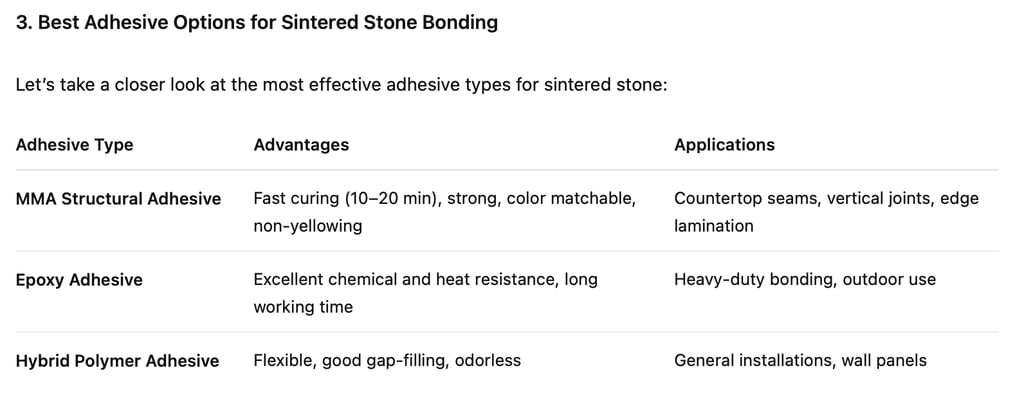
At Spider Adhesive, our MMA adhesive systems are specially engineered for sintered stone.
They offer 10:1 mix ratio, fast setting, high bond strength, and non-yellowing stability, ideal for both indoor and outdoor projects.
Each batch can also be custom color-matched to any sintered stone brand or design — ensuring that every seam remains invisible.
4. Application Tips: How to Achieve Perfect Seams
A perfect sintered stone installation requires not only good material but also proper technique.
Here’s a step-by-step guide:
🧽 1.Surface Preparation
Clean surfaces with acetone or alcohol to remove dust, oil, and residue.
Lightly abrade the bonding area to increase surface roughness.
Ensure surfaces are completely dry before applying adhesive.
🧴 2.Adhesive Mixing
Use a dual-cartridge dispensing gun with a static mixing nozzle.
Dispense a small amount at first to ensure even mixing.
Apply adhesive evenly along the bonding line.
🪚 3.Assembly
Join parts immediately after application.
Clamp lightly to maintain even pressure and alignment.
Avoid excess squeezing that could reduce bond thickness.
⏱️ 4.Curing
Spider MMA adhesives typically cure in 15–20 minutes at room temperature.
Do not move or stress the joint during this time.
Full strength is achieved after 24 hours.
✨ 5.Finishing
Once cured, remove excess adhesive with a scraper.
Polish the seam using fine sandpaper or polishing paste for a flawless finish.
✅ Pro Tip: Always color-match your adhesive to the slab pattern — Spider Adhesive offers hundreds of color formulas to perfectly blend with top sintered stone brands like Dekton, Neolith, and Lapitec.
5. Common Mistakes to Avoid
Even professionals can run into bonding issues if they overlook key steps.
Avoid these common errors:
Skipping surface cleaning → causes weak adhesion
Incorrect mix ratio → results in soft or brittle joints
Over-clamping → squeezes out too much adhesive
Curing under cold conditions → slows down polymerization
Using wrong adhesive type → poor bonding or yellowing over time
A little attention to detail ensures a much stronger, cleaner result.
6. Market Insights: The Rise of Sintered Stone
The sintered stone market has exploded in the past five years, particularly in high-end architecture and kitchen design.
According to market reports, the global sintered stone market is expected to surpass USD 30 billion by 2030, driven by:
Increasing demand for large-format slabs
Growth in luxury real estate and renovation
Rising popularity of eco-friendly, low-maintenance materials
With this growth, the demand for professional-grade adhesives is also accelerating.
Fabricators and contractors need reliable products that can deliver both performance and aesthetics — exactly what Spider Adhesive provides.
7. Why Choose Spider Adhesive for Sintered Stone Projects
At Spider Adhesive, we understand the needs of professional stone fabricators.
Our MMA-based bonding solutions are trusted across industries for their:
⚙️ High bond strength — engineered for dense, low-porosity surfaces
🎨 Perfect color matching — hundreds of shades available
🌞 Non-yellowing & UV resistance — great for outdoor use
⏱️ Fast curing time — increases fabrication efficiency
🧪 20+ years of engineering experience — consistent quality and technical support
We work closely with OEMs, fabricators, and importers around the world to develop adhesives that simplify installation and improve performance — one seam at a time.
Conclusion
Sintered stone may be tough, but bonding it doesn’t have to be.
With the right adhesive, surface prep, and technique, you can achieve seamless, durable, and beautiful joins that stand the test of time.
Whether you’re building a luxury kitchen, commercial façade, or custom furniture, Spider Adhesive delivers the bonding power you need — clean, strong, and lasting.
Spider Adhesive — Seamless Bonding for the Modern Surface.
© 2025 All Rights Reserved, SpiderAdhesive.com


We are a professional adhesive manufacturer and supplier committed to providing advanced bonding solutions for solid surface, quartz, composites, metals, plastics, and other materials.
Contacts:
+86 13686659250
jackspideradhesive@gmail.com
Foshan,China