
The Science Behind Strong Bonds: Understanding Structural Adhesives
In today’s world of advanced manufacturing, adhesives have quietly replaced screws, rivets, and welds in countless applications. From automotive assemblies to wind turbines, from metal furniture to marine composites — it’s adhesive technology that keeps modern products strong, lightweight, and efficient.
Spider Adhesive
12/23/20233 min read
Introduction
In today’s world of advanced manufacturing, adhesives have quietly replaced screws, rivets, and welds in countless applications. From automotive assemblies to wind turbines, from metal furniture to marine composites — it’s adhesive technology that keeps modern products strong, lightweight, and efficient
Among all adhesive types, structural adhesives play the most critical role. They are engineered to bear heavy loads and maintain integrity under vibration, impact, or temperature changes.
In this article, we’ll explore what structural adhesives are, how they work, their key types, and why they’ve become an essential part of nearly every modern industry.
1. What Are Structural Adhesives?
A structural adhesive is a high-strength bonding material designed to join two load-bearing surfaces permanently. Unlike ordinary glues, structural adhesives don’t just “stick” — they become part of the structure, distributing stress evenly across the joint.
They’re typically based on advanced chemistries like:
Epoxy (EP) – for metals, composites, and plastics
Methyl Methacrylate (MMA) – for composites, plastics, and metals
Acrylic (PMMA-based) – for transparent or decorative bonding
When cured, these adhesives create bonds that can rival — or even outperform — mechanical fasteners.
2. Why Use Structural Adhesives Instead of Welding or Screws?
Traditional joining methods like welding, bolts, or rivets can weaken materials by concentrating stress in small areas. Structural adhesives, on the other hand:
✅ Distribute load evenly → reducing stress concentration
✅ Join dissimilar materials → e.g., metal to plastic, composite to metal
✅ Prevent corrosion → no exposed metal joints
✅ Reduce weight → no need for screws or reinforcements
✅ Improve aesthetics → no visible joints or weld marks
That’s why industries like automotive, aerospace, construction, and marine are increasingly relying on adhesives instead of traditional fasteners.
3. Key Types of Structural Adhesives
Let’s look at the three most widely used types — each with unique strengths and ideal applications.
🧪Epoxy Structural Adhesive
Chemistry: Based on epoxy resins and hardeners
Strength: Very high (up to 30 MPa shear strength)
Temperature Resistance: Excellent (up to 150°C or higher)
Applications: Metal-to-metal, composite bonding, electronic components
Advantages: High rigidity, chemical resistance, and long-term durability
Epoxies are ideal for load-bearing assemblies — think aircraft parts, vehicles, and heavy machinery.
⚙️Methyl Methacrylate (MMA) Structural Adhesive
Chemistry: Methyl methacrylate monomer with initiator
Bonding Flexibility: Excellent (absorbs vibration and shock)
Curing Speed: Fast (as quick as 5–15 minutes)
Applications: Composites, plastics, metals, fiberglass
Advantages: Tolerant to surface imperfections and minimal surface prep
MMA adhesives are often called the “bridge between flexibility and strength.” They bond even low-energy surfaces like ABS and PVC where other glues fail.
🔍Acrylic Structural Adhesive
Chemistry: Modified acrylic or methacrylate resins
Transparency: Can be clear or translucent
Applications: Decorative assemblies, signage, transparent joints
Advantages: Easy to use, quick cure, aesthetic bonding
Acrylic adhesives are perfect for architectural panels, decorative furniture, and clear display assemblies where looks matter as much as strength.
4. Key Performance Parameters to Know
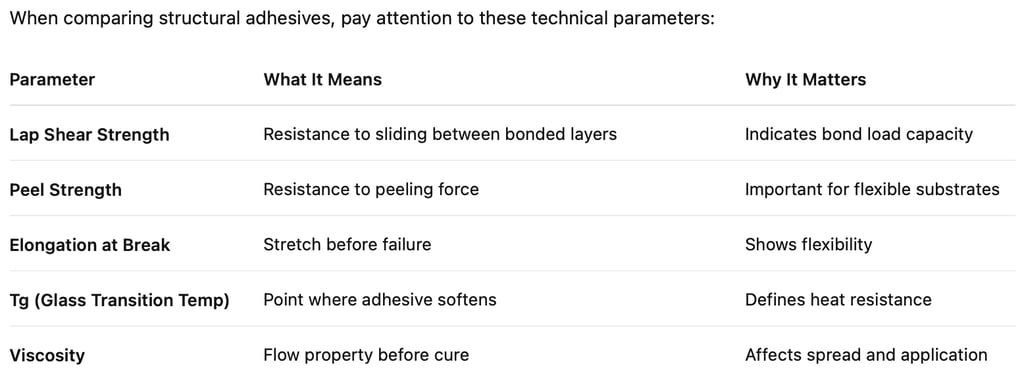
Understanding these helps you match the adhesive to your specific material and environmental conditions.
5. Common Application Areas
Structural adhesives are everywhere — you might not notice them, but they’re holding the world together.
🏗 Construction: Curtain walls, composite panels, aluminum honeycomb bonding
🚗 Automotive: Car body panels, spoilers, plastic bumpers
🚢 Marine: Deck assemblies, hull repairs, FRP components
⚡ Electronics: PCB potting, casing bonding, heat sink attachment
🪑 Furniture: Metal frames, decorative joints, textured boards
As industries push for lighter, cleaner, and more efficient designs, adhesive technology continues to expand its reach.
6. How to Choose the Right Structural Adhesive
Before purchasing, consider these five essential factors:
Material Type: Is it metal, plastic, or composite?
Load Requirements: Static load or dynamic stress?
Operating Conditions: Will it face heat, water, or chemicals?
Curing Time: Do you need fast assembly or longer working time?
Application Method: Manual or automated dispensing system?
💡 Tip: For high-production lines, a dual-cartridge system with static mixing nozzles ensures consistent mixing ratios and stronger bonds.
7. Market Outlook: Why Structural Adhesives Are the Future
The global structural adhesive market is projected to reach over USD 25 billion by 2032, driven by the demand for lightweight and durable materials in transportation, renewable energy, and construction sectors.
Key trends include:
Shift from mechanical fastening to bonding for weight reduction
Growing use of MMA and hybrid adhesives in composite structures
Increasing preference for low-VOC, eco-friendly formulations
For B2B buyers and OEM manufacturers, partnering with a reliable supplier that understands these trends can mean a real competitive edge.
8. Why Choose Spider Adhesive
At Spider Adhesive, we’ve spent over 20 years developing and optimizing high-performance structural adhesives.
Our products are designed to meet the needs of:
Composite and metal fabricators
Automotive and marine manufacturers
Industrial assembly lines and OEM brands
With MMA, epoxy, and acrylic structural adhesives, we deliver:
⚙️ High strength and durability
🔩 Excellent chemical and impact resistance
🌍 Consistent export-grade quality
🧰 OEM/ODM customization and private labeling
When it comes to bonding performance and reliability — Spider Adhesive has you covered.
Conclusion
Structural adhesives aren’t just chemistry — they’re the hidden strength behind modern innovation. Whether you’re building vehicles, assembling panels, or creating durable furniture, the right adhesive ensures your products last longer and perform better.
With Spider Adhesive, you gain more than just glue — you gain engineering expertise, reliable support, and a partnership built to last.
Because in every strong structure, there’s always a Spider bond holding it together.
© 2025 All Rights Reserved, SpiderAdhesive.com


We are a professional adhesive manufacturer and supplier committed to providing advanced bonding solutions for solid surface, quartz, composites, metals, plastics, and other materials.
Contacts:
+86 13686659250
jackspideradhesive@gmail.com
Foshan,China